



 Update
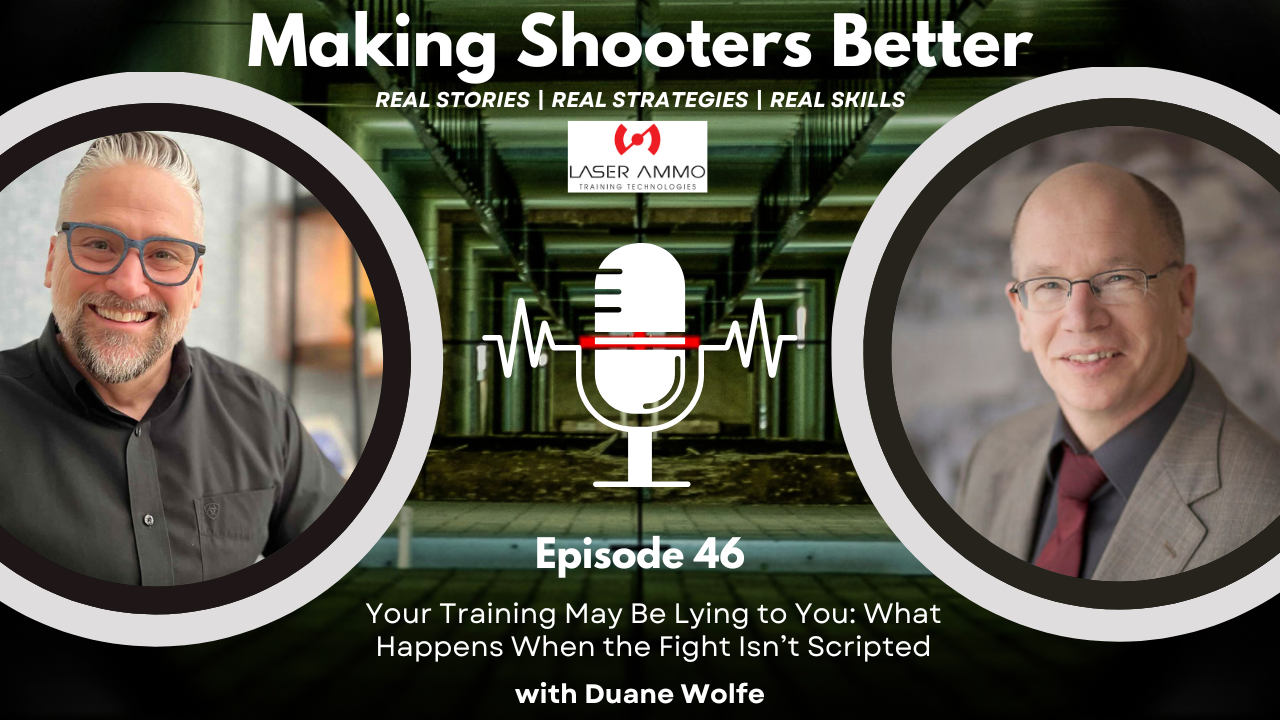
Repetition builds confidence. Familiar drills help shooters develop consistency, improve accuracy, and refine essential skills. But what happens when a situation unfolds differently than expected?
In this episode of Making Shooters Better, host Terry Vaughan welcomes Duane Wolfe, retired Minnesota peace officer, longtime firearms instructor, Police1 columnist, and 2025 ILEETA Trainer of the Year, to examine one of the most important distinctions in defensive training: the difference between knowing how to perform a skill and knowing when and how to apply it.
Drawing on more than 25 years in law enforcement and 28 years as a full-time instructor, Duane shares how human behavior, physiological stress, and unpredictable circumstances can expose limitations that conventional training doesn't always reveal.
The discussion offers valuable lessons for responsible firearm owners, competitive shooters, law enforcement professionals, and instructors looking to make practice more effective.
The Hidden Limitations of Predictable Training
Most shooting drills begin with clear instructions. The shooter knows the target, understands the exercise, and often knows exactly when to begin.
That structure is useful for learning fundamental skills. However, Duane explains that repeatedly practicing with advance knowledge can produce what he calls "training clairvoyance."
What Is Training Clairvoyance?
Training clairvoyance occurs when a person becomes accustomed to knowing what will happen before it happens. Over time, that familiarity may create an unrealistic impression of how quickly the shooter can recognize and respond to an unfamiliar event.
In a scripted exercise, much of the observation and decision-making has already been completed before the drill begins. The participant is primarily practicing execution.
In an unpredictable situation, that preparation isn't available. A person must recognize what is happening, interpret the information, decide what action is appropriate, and then respond.
Why Recognition and Decision-Making Matter
Duane references the OODA loop: Observe, Orient, Decide, and Act. He explains that many conventional drills emphasize the final step without sufficiently developing the preceding ones.
This distinction is important because:
- Recognizing a developing problem takes time.
- Visual information must be interpreted in context.
- Not every unexpected movement or behavior represents a threat.
- Appropriate responses depend on the circumstances.
- Physical proficiency does not automatically guarantee sound decisions.
The goal is not to eliminate structured exercises. They remain important for developing fundamentals. The opportunity lies in adding training that requires participants to observe, interpret, and make decisions rather than simply repeat a known response.
Feed, Read, Succeed: Connecting Awareness to Action
One of Duane's central teaching concepts is a three-part framework he calls "Feed, Read, Succeed."
The approach emphasizes that learning about potential danger isn't the same as recognizing it in real time, and recognizing it isn't necessarily the same as knowing what to do next.
Feed: Learning What to Recognize
The first stage concerns how information is presented during instruction.
Duane explains that training can use photographs, videos, demonstrations, and realistic scenarios to introduce behavioral cues and situational awareness concepts.
The more relevant and memorable the learning experience, the better the opportunity to recognize similar information later.
Read: Understanding What You're Seeing
The second stage involves interpreting those cues in a changing environment.
Duane notes that behavior should be evaluated carefully and in context. An individual looking at an officer's equipment, for example, could have several different motivations.
Effective training should develop observation and judgment without encouraging automatic assumptions about another person's intentions.
Succeed: Connecting Recognition to an Appropriate Response
The final stage concerns developing practical responses based on what has been recognized.
Depending on the situation, an appropriate response might involve creating distance, communicating clearly, slowing an interaction, seeking assistance, or taking another lawful and proportionate action.
The key lesson is that understanding a concept in the classroom doesn't guarantee that it can be applied under pressure.
Duane encourages instructors to connect what students see with thoughtful, practiced decision-making.
Lessons From a Real-World Assault
During the conversation, Duane recounts a violent encounter from his law enforcement career that influenced how he thinks about warning signs, distance, and response time.
While handling a DUI arrest, he encountered an individual who repeatedly refused instructions. When Duane approached to address the individual's smoking, the situation quickly escalated into a physical assault.
Looking back, Duane identifies several decisions he would reconsider with the benefit of additional experience.
His account reinforces an important lesson: recognizing potential problems early and maintaining appropriate distance can provide more options before an interaction deteriorates.
It also highlights the value of reviewing difficult experiences constructively rather than assuming that every outcome could have been predicted.
Learning Without Becoming Your Own Worst Critic
Terry and Duane also discuss the importance of internal dialogue after stressful events.
Both acknowledge that people naturally replay difficult experiences, question their choices, and consider what they might have done differently.
However, meaningful reflection requires balancing honest self-evaluation with constructive thinking.
Rather than allowing criticism to become the only response, individuals can focus on what they learned and how those lessons can improve future preparation.
Competition Skills vs. Defensive Readiness
Competitive shooting offers numerous benefits. It encourages practice, develops measurable shooting skills, and challenges participants to perform consistently.
Duane recognizes these advantages while cautioning against assuming that success in competition automatically translates into defensive readiness.
Different Environments Require Different Skills
In many competitions, shooters have opportunities to examine a course, understand the scoring system, and anticipate the tasks they will perform.
That format tests specific skills under established rules, but it doesn't fully reproduce an encounter where the circumstances and appropriate responses are initially unknown.
Duane compares the distinction to practicing football throws versus participating in an actual game. Repetition can improve a necessary skill without representing every challenge involved in using that skill effectively.
For defensive preparation, additional considerations include:
- Recognizing and interpreting unexpected information.
- Making decisions without advance knowledge of the scenario.
- Distinguishing genuine threats from non-threatening behavior.
- Considering the presence and safety of other people.
- Managing stress and uncertainty.
- Choosing responses appropriate to the situation.
Competition and defensive training need not be viewed as competing approaches. Instead, shooters and instructors should understand what each training environment develops and where additional practice may be beneficial.
How Stress Can Change Performance
A major part of Terry and Duane's discussion focuses on the effects of stress on perception, physical responses, and decision-making.
Duane argues that trainers must consider how people actually behave under pressure rather than assume that calm-range performance will remain unchanged in every environment.
Vision, Attention, and Information Processing
During stressful situations, a person's attention may narrow, visual priorities may change, and processing information may become more difficult.
Duane discusses how these responses can influence shooting performance and explains why he has experimented with training methods that account for changes in visual focus.
He also emphasizes an often-overlooked distinction when reviewing real-world incidents: a camera recording does not necessarily reveal what a person noticed, understood, or believed at the time.
Video provides valuable information, but reviewing an event afterward in a calm environment is not equivalent to experiencing it as it unfolds.
Why Training Must Consider Human Physiology
Duane describes his experience observing officers during force-on-force exercises and comparing their performance with what they demonstrated during conventional range training.
These observations led him to question certain assumptions about shooting positions, visual attention, and the relationship between qualification scores and performance during realistic scenarios.
His broader message is that instructors should continually examine whether their methods reflect the demands students may actually experience.
Effective training should combine technical proficiency with awareness, decision-making, and realistic performance expectations.
Making Training More Realistic Without Sacrificing Safety
When training becomes less predictable, carefully designed safety procedures become even more important.
Duane discusses the benefits of scenario-based instruction, reactive targets, video simulators, and force-on-force exercises conducted with appropriate training equipment and controls.
These methods can give participants opportunities to recognize changing information and make decisions without requiring every exercise to involve live ammunition.
Why Unscripted Scenarios Add Value
Realistic training is not simply about increasing intensity. It is about introducing meaningful decisions and evaluating how participants respond.
Depending on the learning objective, scenarios can challenge students to:
- Identify relevant behavioral cues.
- Recognize when additional information is needed.
- Distinguish between threatening and non-threatening situations.
- Practice communication and de-escalation.
- Maintain awareness of their surroundings.
- Make appropriate decisions under controlled pressure.
Duane emphasizes that realistic exercises must follow established safety protocols and use equipment appropriate for the training environment.
Carefully supervised inert training tools and dedicated simulation systems can support valuable learning without relying on live-fire exercises for every training objective.
How Laser-Based Training Supports Consistent Practice
Terry explains how Laser Ammo training equipment can help individuals and law enforcement departments create more frequent opportunities to practice.
He discusses Laser Ammo's CQB in a Box system, which uses laser-responsive targets that can be positioned in different configurations to introduce variety into training.
He also describes departments using simulator-based practice (like the Smokeless Range®) as a convenient way for officers to maintain familiarity with their equipment and reinforce foundational skills.
One of the benefits of laser-based training is that it can reduce some of the logistical barriers associated with regular range visits.
For both individual shooters and departments, properly designed dry-fire exercises can provide additional opportunities to reinforce safe handling, consistency, and selected decision-making skills.
Dry-fire and laser-based training are supplements to live-fire instruction, not replacements. Every session should follow appropriate firearm safety procedures, including verifying that firearms and training areas are configured safely for the exercise.
Breathing, Stress Regulation, and Better Decision-Making
Another valuable part of the episode explores techniques for managing physiological arousal.
Duane describes how he incorporated breathing practices into training and observed relationships between participants' stress levels and their shooting performance.
While he acknowledges limitations in his informal observations, the results encouraged him to continue studying the connection between stress regulation and performance.
Box Breathing and Cyclic Sighing
Duane discusses two breathing techniques: box breathing and cyclic sighing.
Box breathing uses a controlled pattern of inhaling, pausing, exhaling, and pausing again. Cyclic sighing uses a different breathing pattern that emphasizes a longer exhalation.
Both approaches are discussed as potential tools for managing arousal and improving a person's ability to regain composure.
They are not guarantees of better performance in an emergency, but they can be useful components of a broader approach to stress management.
Preparing Before Stress Occurs
Duane explains that people may not have time to consciously regulate their breathing when an unexpected incident begins.
For that reason, he places value on developing stress-management habits and practicing them within appropriate training environments.
His message extends beyond shooting performance. Understanding personal reactions to stress can benefit communication, judgment, and everyday decision-making.
Training Smarter Means Maintaining Your Skills
Building proficiency is only one part of preparation. Maintaining it requires consistent attention.
Duane points out that law enforcement agencies must balance limited training budgets, qualification requirements, available facilities, and the operational demands placed on officers.
He also discusses examples of departments reevaluating the time devoted to formal qualification compared with more practical training.
His point is not that marksmanship qualification should disappear. Instead, qualification should serve its intended purpose without consuming opportunities to develop additional capabilities.
The Value of Frequent, Purposeful Repetition
Short, well-designed practice sessions can reinforce fundamentals and create additional opportunities to evaluate performance.
For individual shooters, this might mean combining regular dry-fire work with supervised live-fire training and periodic professional instruction.
For departments, it may mean making safe simulation equipment more accessible so officers can refresh appropriate skills between formal training events.
Laser Ammo's training philosophy aligns with this approach: make practice convenient, constructive, measurable where appropriate, and focused on continual improvement.
Questions Worth Asking About Your Training
After listening to Terry and Duane, consider the following questions:
- Does my practice challenge me to make decisions, or only repeat familiar movements?
- Am I developing awareness and judgment alongside physical shooting skills?
- Have I experienced safe, supervised scenario-based training?
- Do I understand how stress may influence my performance?
- Am I practicing frequently enough to maintain what I've learned?
- Does my training include opportunities for constructive feedback?
- Am I building skills that support responsible, lawful responses to unexpected situations?
These questions can help identify areas for improvement without dismissing the value of foundational training.
Watch the Full Conversation
How much of your confidence comes from genuine adaptability, and how much comes from knowing exactly what the next drill will require?
In this episode of Making Shooters Better, Terry Vaughan and Duane Wolfe take that question far beyond the shooting range. Hear Duane's firsthand law enforcement experiences, his observations from years of instructing officers, and the lessons that shaped his approach to stress, awareness, and realistic training.
Watch the full conversation in the video embedded below to explore how thoughtful changes to training can reveal overlooked weaknesses and support more capable, responsible performance.
For more conversations with experienced instructors and shooting professionals, subscribe to Laser Ammo's YouTube channel and follow Making Shooters Better.
To connect with Duane Wolfe, learn more about his instructional background, or inquire about training and speaking opportunities, visit his LinkedIn profile.
Keep learning, practice responsibly, and make every training session count.
Listen to More Episodes
You can listen to Making Shooters Better on your favorite podcast platform. Follow the show here:
- Buzzsprout: https://www.buzzsprout.com/2532363/follow
- Amazon Music https://music.amazon.com/podcasts/8156b69d-5ad9-46e9-9a4d-2baff1fbc9ef/making-shooters-better
- Apple Podcasts: https://podcasts.apple.com/podcast/id1849466402
- Spotify: https://open.spotify.com/show/5EhHThJEeV5QZ0QQn5n5CF
- Podcast Index: https://podcastindex.org/podcast/7559749
- Overcast: https://overcast.fm/itunes1849466402
- Castro: https://castro.fm/itunes/1849466402
- Podchaser: https://www.podchaser.com/podcasts/making-shooters-better-6264190
- Goodpods: https://www.goodpods.com/podcasts-aid/1849466402
- TrueFans: https://truefans.fm/65cb6a8a-c2eb-524e-b742-257cbe7bcfce
- Castbox: https://castbox.fm/vic/1849466402
- Podcast Addict: https://podcastaddict.com/podcast/making-shooters-better/6158896
- iHeartRadio: https://www.iheart.com/podcast/1333-making-shooters-better-303769503/
- Pandora: https://www.pandora.com/podcast
- TuneIn: https://tunein.com/podcasts/