



 Update
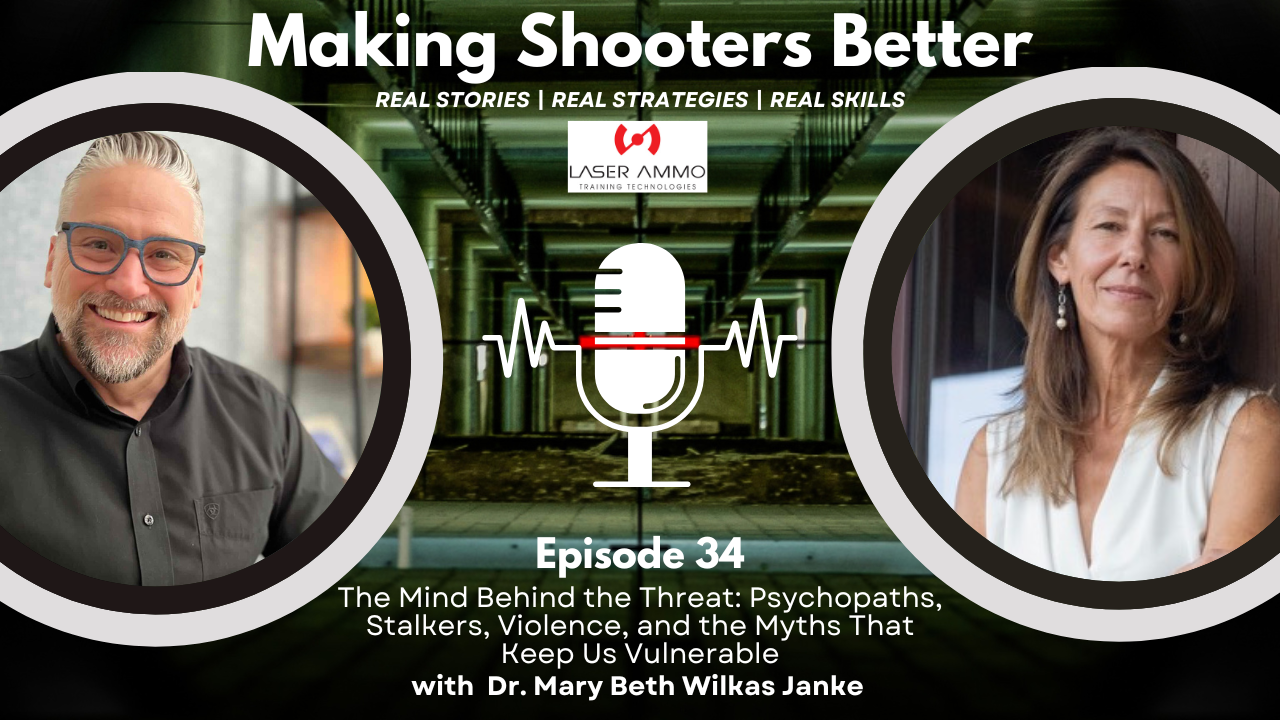
The Mind Behind the Threat
What can dangerous people teach us about being human?
That question sits at the center of this episode of Making Shooters Better as Dr. Mary Beth Wilkas Janke returns to the podcast for an engaging conversation about forensic psychology, criminal behavior, and the practical lessons that help people recognize danger before it becomes violence.
With a career that spans service in the United States Secret Service and years as a forensic psychologist, Dr. Janke offers a rare perspective that combines protective operations with the science of human behavior. Rather than encouraging fear or paranoia, she explains how understanding behavior can help ordinary people become more aware, more confident, and ultimately safer.
From Protecting People to Understanding Criminal Minds
Dr. Janke shares how her experience protecting government officials eventually led her toward forensic psychology. Working investigations and protective assignments gave her firsthand exposure to human behavior, while graduate studies provided the language and research that explained many of the instincts she had already developed.
Throughout the discussion, she explains that experience and education complement one another. Observation can identify patterns, but psychology helps explain why those patterns exist.
Danger Doesn't Always Look Dangerous
One of the biggest misconceptions surrounding violent offenders is that they somehow "look" dangerous. In reality, many offenders appear completely ordinary.
The conversation explores why people naturally want clear warning signs and easy answers, even though real life is often far more complicated.
- Violent offenders come from every background.
- Many crimes are situational rather than carefully planned.
- Psychopathy exists on a spectrum.
- Not every dangerous person fits a stereotype.
Recognizing this reality helps people rely less on appearances and more on behavior.
Psychopaths, Sociopaths, and Common Misunderstandings
Dr. Janke discusses the differences between psychopathy, sociopathy, and antisocial personality disorder while explaining that human behavior rarely fits neatly into simple labels.
She also explains why society often wants every violent act to be explained by mental illness. While mental illness can sometimes play a role, many offenders do not suffer from psychiatric disorders. Instead, personality disorders, environmental influences, desperation, and situational pressures all contribute differently depending on the individual.
The discussion reminds listeners that understanding behavior requires nuance rather than assumptions.
Can Violence Be Predicted?
No prediction is perfect, but professionals do look for recurring behavioral patterns.
Among the strongest indicators discussed in the episode are:
- Past behavior.
- Escalating patterns.
- Boundary testing.
- Prior criminal history.
- Relationship history.
- Life stressors and significant behavioral changes.
Rather than searching for one dramatic warning sign, risk assessment focuses on patterns that repeat over time.
The Politeness Trap
One of the most valuable sections of the conversation examines why decent, empathetic people sometimes become easier targets.
Many people ignore uncomfortable situations because they don't want to appear rude, judgmental, or unfair. Unfortunately, individuals who manipulate others often rely on exactly that hesitation.
Learning to recognize small boundary violations before they become larger problems is an important part of personal safety.
Stalking and Escalating Behavior
Dr. Janke explains that stalking often begins long before most people recognize it as dangerous.
What initially appears to be unwanted attention can gradually become a pattern of surveillance, intimidation, or control.
The episode explores:
- Common misconceptions about stalking.
- How stalking behaviors escalate.
- Mistakes victims often make early.
- Why documentation matters.
- The limits of legal protections.
Understanding these patterns early can make a significant difference in protecting yourself and others.
Domestic Violence Is About Control
The discussion also examines why abusive relationships are so difficult to leave.
Rather than asking, "Why doesn't someone just leave?" Dr. Janke explains the emotional, psychological, and practical realities that trap many victims.
Topics include:
- Coercive control.
- Emotional manipulation.
- Isolation.
- Financial dependence.
- The cycle of violence.
- Shame and fear.
Understanding these dynamics helps replace judgment with compassion while encouraging earlier intervention when warning signs appear.
Body Language, Fear, and Human Judgment
Can you really tell when someone is lying?
According to Dr. Janke, body language can provide useful context, but it should never be treated as absolute proof of deception.
The conversation encourages listeners to avoid becoming overconfident while continuing to observe behavioral patterns, context, and inconsistencies over time.
Fear is also discussed as an important survival tool. Rather than ignoring uncomfortable feelings, learning when fear is providing useful information can improve personal safety without creating unnecessary anxiety.
Practical Lessons for Everyday Life
Perhaps the most valuable takeaway from this episode is that becoming safer does not require becoming paranoid.
Instead, it means becoming more observant, recognizing patterns sooner, maintaining healthy boundaries, and trusting evidence over assumptions.
Awareness, preparation, and sound judgment remain some of the most effective personal safety tools available.
Watch the Full Conversation
This episode offers far more than a discussion about crime. It explores human behavior, psychology, and the practical lessons that help us recognize manipulation, understand risk, and make better decisions under pressure. Whether you're a firearms owner, instructor, law enforcement professional, or simply interested in understanding people more effectively, this conversation delivers valuable insights that are difficult to find anywhere else.
Be sure to watch the full interview, subscribe to the Laser Ammo YouTube channel for future episodes of Making Shooters Better, and follow Dr. Mary Beth Wilkas Janke to learn more about forensic psychology, criminal behavior, and personal safety.
Listen to More Episodes
You can listen to Making Shooters Better on your favorite podcast platform. Follow the show here:
- Buzzsprout: https://www.buzzsprout.com/2532363/follow
- Amazon Music https://music.amazon.com/podcasts/8156b69d-5ad9-46e9-9a4d-2baff1fbc9ef/making-shooters-better
- Apple Podcasts: https://podcasts.apple.com/podcast/id1849466402
- Spotify: https://open.spotify.com/show/5EhHThJEeV5QZ0QQn5n5CF
- Podcast Index: https://podcastindex.org/podcast/7559749
- Overcast: https://overcast.fm/itunes1849466402
- Castro: https://castro.fm/itunes/1849466402
- Podchaser: https://www.podchaser.com/podcasts/making-shooters-better-6264190
- Goodpods: https://www.goodpods.com/podcasts-aid/1849466402
- TrueFans: https://truefans.fm/65cb6a8a-c2eb-524e-b742-257cbe7bcfce
- Castbox: https://castbox.fm/vic/1849466402
- Podcast Addict: https://podcastaddict.com/podcast/making-shooters-better/6158896
- iHeartRadio: https://www.iheart.com/podcast/1333-making-shooters-better-303769503/
- Pandora: https://www.pandora.com/podcast
- TuneIn: https://tunein.com/podcasts/