



 Update
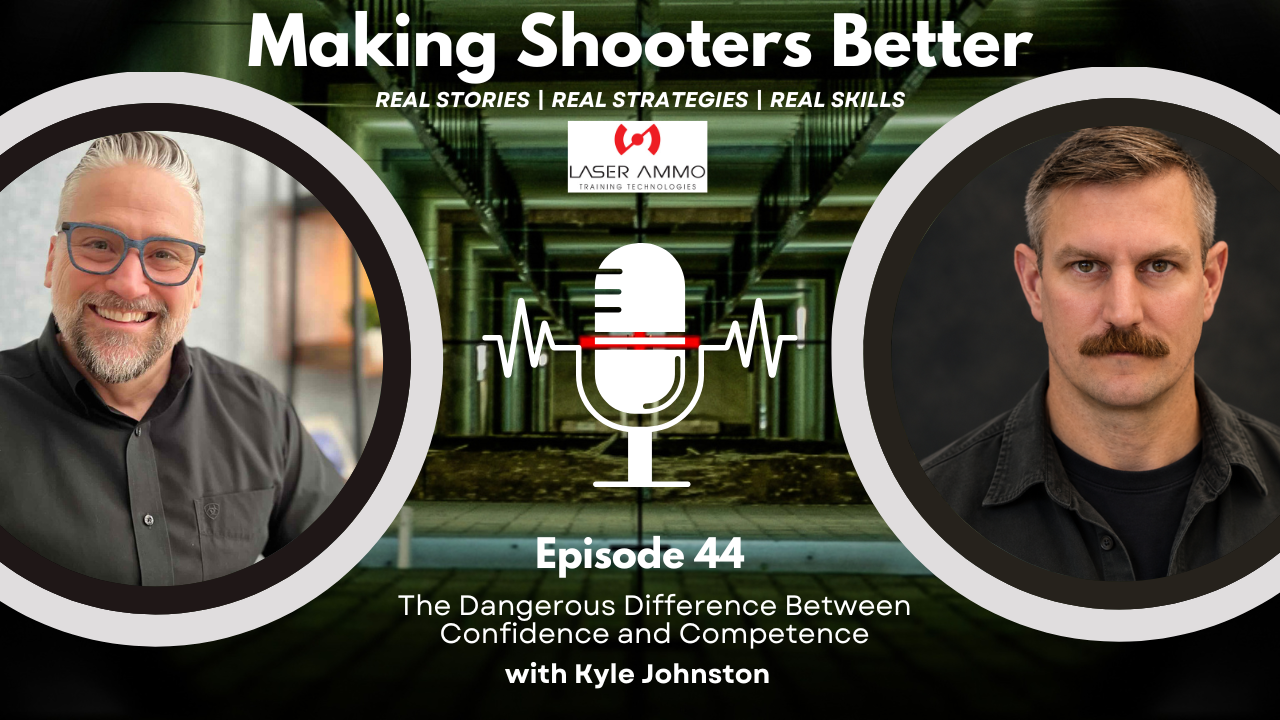
It is possible to spend years around firearms, shoot regularly, and feel confident in your ability only to discover that confidence begins to disappear when the training becomes more demanding.
Kyle Johnston experienced exactly that.
In this episode of Making Shooters Better, Kyle joins Terry Vaughan to discuss his journey from the Marine Corps into filmmaking and media, his eventual return to military service as a Green Beret, and the lessons that process taught him about skill, humility, and purposeful firearms training.
One idea runs throughout their conversation: simply doing something regularly does not necessarily mean you are training to become better at it.
From the Marine Corps to Filmmaking and Back Into Service
Kyle began shooting when he was young, in part because his father worked in law enforcement and later in nuclear security. He entered the Marine Corps in 2006, completed four years of service and multiple deployments, and then moved into a very different world.
Using the GI Bill, Kyle went back to school and ultimately discovered an interest in editing, filmmaking, and media. That interest took him to London, Los Angeles, and eventually into running his own production studio in Cleveland.
But military service remained important to him.
After years of trying to return to the Marine Corps Reserve, Kyle discovered the Special Forces opportunities available through the National Guard. That eventually led him through Special Forces selection, Ranger School, and the Special Forces qualification process before joining the 19th Special Forces Group.
Today, he is able to combine both sides of his background through his military service and his creative work with Unit Solutions.
The Range Gave Him a Reality Check
Before returning to structured military training, Kyle believed he was a reasonably capable shooter. He had been shooting since childhood. He had served in the Marines. He continued visiting the range during his years outside the military. On a static indoor range, he could produce good groups.
Then the conditions changed. Once training introduced faster shooting, movement, multiple shots, reloads, timers, and other measurable demands, the ability Kyle thought he had did not hold up the same way. That experience exposed an important distinction.
Shooting and Training Are Not the Same Thing
Going to the range can be enjoyable and valuable. But without an objective, it is easy to repeatedly practice what already feels comfortable. Training adds intent.
Instead of simply firing a few hundred rounds, a shooter might choose a particular skill and determine how performance will be evaluated.
That could mean working on:
- Draw consistency
- Reloads
- Target transitions
- Accuracy at a defined pace
- Movement between or while engaging targets where range rules safely allow it
- Grip and presentation
- Performance against a timer or another objective standard
Once results become measurable, weaknesses become much harder to ignore.
Comfortable Practice Can Create Misleading Confidence
A shooter who repeatedly performs the same comfortable task can become extremely familiar with that task. The danger is assuming that familiarity represents broader competence. Kyle describes experiencing that firsthand.
His static shooting had given him confidence. Structured training gave him information. That difference matters because productive practice is not only about confirming what you can already do. It is also about identifying the areas where your performance begins to break down.
Discovering a weakness can be frustrating, but it also gives your next practice session a purpose.
Give Your Training a Destination
Kyle compares firearms training with preparing for a marathon. If the goal is to run 26.2 miles, you do not simply exercise randomly and hope everything works out. You identify the destination, create a plan, measure progress, and adjust that plan as weaknesses appear.
Shooting can be approached the same way. A useful training process might look like this:
- Choose one skill you want to improve.
- Establish your current performance.
- Select drills that address that skill.
- Record measurable results when appropriate.
- Practice consistently.
- Retest and adjust the plan.
The goal does not need to be dramatic. It simply needs to provide direction.
Consistency Matters Because Skills Fade
Another lesson Kyle learned after his long break in military service was how quickly previously developed abilities could deteriorate. Skills he remembered being good at were not automatically waiting for him at the same level when he returned years later. Firearms skills work the same way.
For many shooters, getting to a live-fire range every week is unrealistic. Work, family responsibilities, travel, range access, ammunition costs, and other demands can create significant gaps between sessions. That is where safe, responsible dry-fire and at-home training can provide useful additional repetitions.
Use At-Home Training to Support Live Fire
Kyle discusses how being able to fit short training sessions into his schedule has helped him work on specific skills between range visits.
A shooter may only have 10 or 15 minutes available, but those minutes can still be purposeful.
Depending on the equipment and training environment, at-home practice can help reinforce areas such as:
- Grip
- Presentation
- Sight acquisition
- Trigger control
- Reload mechanics
- Target transitions
- Consistent setup and repetition
Dry-fire and laser-based training are not replacements for live fire. Live-fire practice remains important for working with recoil and validating skills with the firearm and ammunition you actually use.
Instead, at-home training gives shooters another opportunity to practice safely and consistently between live-fire sessions. Always verify that your firearm is unloaded, remove live ammunition from the training area, choose an appropriate safe direction, and follow all applicable firearm safety practices before beginning dry-fire training.
Train What Needs Work, Not Just What Looks Good
Kyle gives a recent example from his own practice. While working on lateral movement and engaging separate targets, he noticed that his performance was either slower than he wanted or became less accurate when he increased his speed. That gave him useful information.
Instead of avoiding the weak area, he now had something specific to address. This mindset can make practice much more productive. If every session is designed around the skills where you already perform well, the session may feel successful without producing much improvement.
Sometimes the most useful training session is the one that clearly shows you where more work is required.
Good Techniques Should Stay Adaptable
The conversation also moves beyond individual shooting mechanics into a broader discussion about training philosophy. Kyle describes working with experienced military teams that sometimes approached the same problem differently. Both approaches could be effective, and each group could learn something from the other.
That experience reinforced the importance of avoiding the idea that every technique has one universally correct answer. Training methods evolve. Context changes. New information becomes available.
Good shooters and instructors should be willing to evaluate what works, understand why it works, and continue learning rather than turning a particular technique into unchangeable doctrine.
The Shooting Community You Meet in Person
Kyle and Terry also discuss an interesting contrast within the firearms community. Online conversations can sometimes make shooting culture appear unusually argumentative. Post a technique publicly and someone will almost certainly explain why it is wrong.
Kyle's experience in person has been very different. At ranges and training events, he has repeatedly found shooters willing to share equipment, offer suggestions, answer questions, and help other people improve. That matters especially for newer shooters.
Someone entering the firearms community for the first time may already feel intimidated by unfamiliar equipment, range noise, terminology, or the skill displayed by more experienced shooters.
Experienced shooters have an opportunity to make that first experience better by being welcoming, patient, and safety-focused.
Competence Requires Humility
Perhaps the strongest lesson in Kyle's story is that improvement often begins when a shooter becomes willing to discover what they cannot yet do. Confidence has value. But confidence becomes more useful when it is supported by demonstrated skill.
Timers, drills, objective standards, instructors, competitions, and training partners can all provide feedback that comfortable practice may not. The result is not about proving that someone is a bad shooter. It is about replacing assumptions with information and then using that information to train more intelligently.
Watch the Full Conversation
Watch the full episode of Making Shooters Better to hear Kyle Johnston explain how his transition back into military training challenged his assumptions about his own shooting ability, what Special Forces training taught him about maintaining perishable skills, and why he believes clear goals and consistent practice are essential for continued improvement.
Kyle and Terry also explore adaptability in training, the difference between online criticism and real-world range culture, balancing practice with family responsibilities, and why experienced shooters can play an important role in helping new shooters feel welcome.
After watching, subscribe to Laser Ammo's channel for more conversations with instructors, competitors, military and law enforcement professionals, and shooters who are committed to learning and making shooters better.
Follow Kyle and Unit Solutions
Learn more about Kyle's work with Unit Solutions and follow their latest training content:
- Website: https://unitsolutions.com/
- Instagram: https://www.instagram.com/unit.solutions/reels/
Listen to More Episodes
You can listen to Making Shooters Better on your favorite podcast platform. Follow the show here:
- Buzzsprout: https://www.buzzsprout.com/2532363/follow
- Amazon Music https://music.amazon.com/podcasts/8156b69d-5ad9-46e9-9a4d-2baff1fbc9ef/making-shooters-better
- Apple Podcasts: https://podcasts.apple.com/podcast/id1849466402
- Spotify: https://open.spotify.com/show/5EhHThJEeV5QZ0QQn5n5CF
- Podcast Index: https://podcastindex.org/podcast/7559749
- Overcast: https://overcast.fm/itunes1849466402
- Castro: https://castro.fm/itunes/1849466402
- Podchaser: https://www.podchaser.com/podcasts/making-shooters-better-6264190
- Goodpods: https://www.goodpods.com/podcasts-aid/1849466402
- TrueFans: https://truefans.fm/65cb6a8a-c2eb-524e-b742-257cbe7bcfce
- Castbox: https://castbox.fm/vic/1849466402
- Podcast Addict: https://podcastaddict.com/podcast/making-shooters-better/6158896
- iHeartRadio: https://www.iheart.com/podcast/1333-making-shooters-better-303769503/
- Pandora: https://www.pandora.com/podcast
- TuneIn: https://tunein.com/podcasts/