



 Update
In this episode of Making Shooters Better, Terry Vaughan sits down with Tim Pearce, a former law enforcement officer whose career in South Central Los Angeles exposed him to the realities of violence, stress, and human behavior under pressure. Tim’s experience in gang units—and a devastating personal tragedy—reshaped how he views training, survival, and preparedness.
When Real Life Breaks Traditional Training
Most firearms training happens in controlled environments. Two hands on the gun. Clear sight picture. Minimal stress. Tim explains why those conditions rarely reflect reality when violence erupts.
- Stress disrupts decision-making and cognitive processing
- Fine motor skills degrade under pressure
- Physiological responses can override training habits
Under real threat, the brain prioritizes survival. Without exposure to realistic stress, shooters often freeze or make poor decisions—not because they lack skill, but because they lack preparation for how the body reacts.
The Invisible Weight of the Uniform
Policing carries more than physical danger. Tim describes the constant pressure officers feel from public perception, policy constraints, and complaint-driven systems.
- Ongoing judgment in public spaces
- Fear of administrative consequences
- Accumulated mental stress across years of service
These factors shape how officers act in critical moments, often adding hesitation when decisiveness matters most.
A Personal Tragedy That Changed Everything
A single incident altered Tim’s life and career forever. His partner, Christina, was critically injured during a foot pursuit, suffering catastrophic physical and neurological trauma.
Her injury revealed hard truths about violence and survival:
- Severe blood loss rapidly affects brain function
- Emotional regulation and impulse control can disappear
- Trauma can permanently alter personality and coping mechanisms
This experience forced Tim to confront a reality most training never addresses: people fight while injured, impaired, and overwhelmed.
From Experience to Innovation
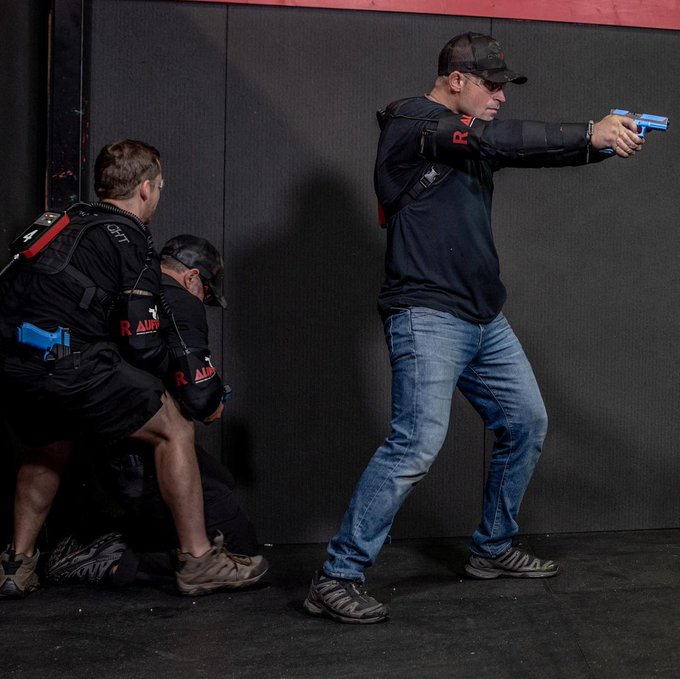
Determined to close the gap between training and reality, Tim began exploring ways to simulate injury and stress safely. That exploration led to the development of AUFIRE, a wearable training system designed to replicate the physical disruption caused by being injured.
- Simulates loss of limb function
- Forces adaptive problem-solving under stress
- Builds confidence through controlled exposure
The goal is not discomfort for its own sake, but realistic preparation that teaches shooters how to continue functioning when things go wrong.
Why Simulated Stress Matters

Experiencing realistic stress during training changes how people respond in real incidents.
- Improves adaptability and decision flow
- Reduces hesitation after injury or surprise
- Builds mental resilience alongside technical skill
Repeated exposure helps shooters move past panic and toward purposeful action.
Training Beyond Gear and Tactics
Tim emphasizes that equipment alone won’t solve the problem. Policy, culture, and mindset matter just as much.
Training should include:
- Baseline fundamentals and conditioning
- Progressive decision-making under stress
- After-action discussions addressing mental and emotional impact
Preparing for violence means preparing the whole person, not just their trigger finger.
Watch the Full Conversation
This episode dives deeper into the psychology of stress, the realities of policing, and how experience-driven training can save lives. Watching the full conversation provides valuable insight into how mindset, resilience, and realistic preparation intersect when it matters most.
Hearing Tim’s story in his own words brings clarity to why stress-based training is not optional—it’s essential.
Following Tim Pearce’s Work
Tim continues to focus on helping officers and trainers prepare for real-world encounters through realistic, repeatable stress exposure. His work centers on acknowledging how the human body reacts under threat and building training that reflects those realities.
Listen to More Episodes
You can listen to Making Shooters Better on your favorite podcast platform. Follow the show here:
- Buzzsprout: https://www.buzzsprout.com/2532363/follow
- Amazon Music https://music.amazon.com/podcasts/8156b69d-5ad9-46e9-9a4d-2baff1fbc9ef/making-shooters-better
- Apple Podcasts: https://podcasts.apple.com/podcast/id1849466402
- Spotify: https://open.spotify.com/show/5EhHThJEeV5QZ0QQn5n5CF
- Podcast Index: https://podcastindex.org/podcast/7559749
- Overcast: https://overcast.fm/itunes1849466402
- Castro: https://castro.fm/itunes/1849466402
- Podchaser: https://www.podchaser.com/podcasts/making-shooters-better-6264190
- Goodpods: https://www.goodpods.com/podcasts-aid/1849466402
- TrueFans: https://truefans.fm/65cb6a8a-c2eb-524e-b742-257cbe7bcfce
- Castbox: https://castbox.fm/vic/1849466402
- Podcast Addict: https://podcastaddict.com/podcast/making-shooters-better/6158896
- iHeartRadio: https://www.iheart.com/podcast/1333-making-shooters-better-303769503/
- Pandora: https://www.pandora.com/podcast
- TuneIn: https://tunein.com/podcasts/