



 Update
Using Scaled Targets for Dry Fire Training at Home
Dry fire training is one of the most effective ways to improve shooting skills without spending endless money on ammunition, range fees or traveling to the range... not to mention more time. Practicing presentation, trigger control, sight alignment, and target transitions can all be done safely at home with the right tools. Many competitive shooters, firearms instructors, law enforcement professionals and EDC folks incorporate dry fire into their regular training routine because repetition builds consistency and confidence.
One challenge with training at home, however, is space. Most homes simply don’t allow you to stand 10, 15, or 25 yards away from a full-size target like you would at a range.. and sometimes not even 7 yards with room to place targets. So how do you simulate those distances indoors?
The answer is scaled targets.
By using smaller targets and standing proportionally closer, you can replicate the visual appearance and target area of a full-size target at distance. This allows you to train realistically even in a small room, basement, or garage.
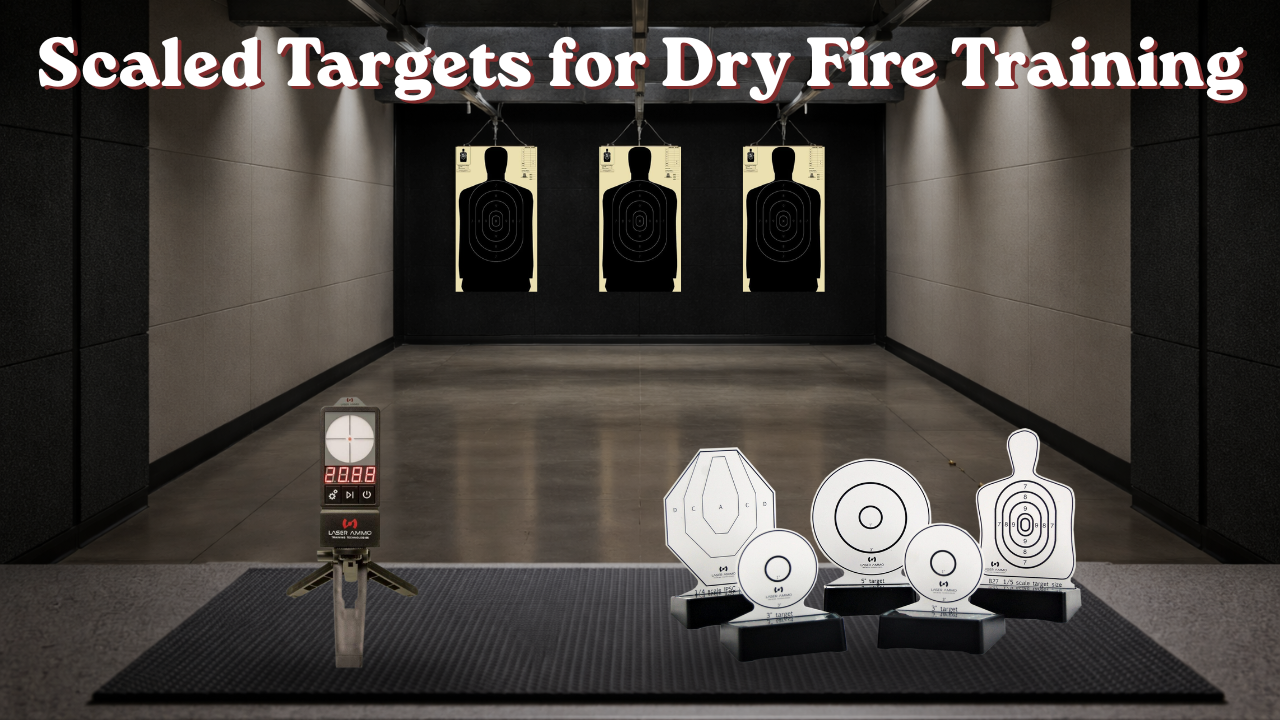
Scaled Targets & How They Work
Scaled targets reduce the size of the target while keeping the proportions the same. When you stand closer to the smaller target, it appears the same size through your sights as a full-size target placed farther away.
Here are some common scaling guidelines used in dry fire training:
- 1/2 scale target – 1 yard then equals 2 yards
- Example: To simulate shooting a full-size target at 20 yards, place a 1/2 scale target at 10 yards.
- 1/3 scale target – 1 yard then equals 3 yards
- Example: To simulate a 15-yard shot, place a 1/3 scale target at 5 yards.
- 1/6 scale target – 1 yard then equals 6 yards
- Example: To simulate an 18-yard shot, place a 1/6 scale target at 3 yards.
This concept works because what your eyes see through the sights is based on angular size, not the physical distance alone. A properly scaled target at a shorter distance can replicate the same sight picture you would see on a full-size target downrange.
We found this blog and thought that it was another great explanation of the math behind scaling targets, because understanding (PTH / ATH) *DTS - DfPT... just might not make sense and they explain it well. (Where PTH - printed target height, inches; ATH - actual target height, inches; DTS - distance to simulate, yards; DfPT - distance from printed target, yards.)
Further, feel free to check out this scale conversion calculator to determine ratios for different targets.
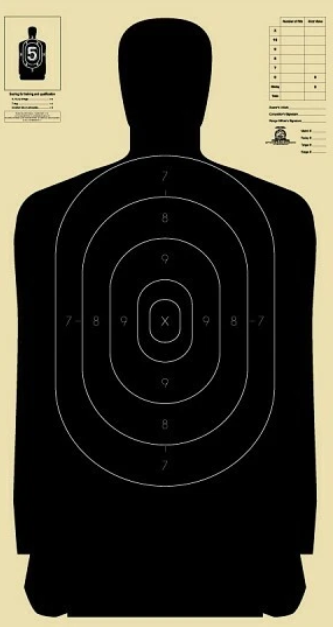
Simulating a B-27 Target with LaserPET™ II - Example
An official B-27 full sized silhouette target typically measures 24" wide by 45" tall.
The active target zone on the LaserPET™ II electronic target is just under 2 inches.
Using the scale conversion calculator above and comparing target height, that works out to roughly a 1:22 scale.
What that means in practice:
- If you stand 1 yard from the LaserPET™ II, you are roughly simulating a full-size B-27 target at 22.5 yards.
- If you want to simulate a 10-yard shot on a full-size B-27, you would place the LaserPET™ II about 0.44 yards away, which is about 16 inches.
How to Calculate Scaled Target Distance
When using scaled targets for dry fire, there are two useful calculations:
- DTS = Distance To Simulate
- DfPT = Distance from Printed Target
In simple terms:
- If you know how far away you are standing from the target, you can calculate what full-size distance you are simulating.
- If you know what full-size distance you want to simulate, you can calculate how far away to place the target.
The Basic Formula
Scale Factor × DfPT = DTS
Or, if solving in reverse:
DfPT = DTS ÷ Scale Factor
For the LaserPET™ II, using the height comparison to a full-size B-27 target:
- B-27 target height = 45 inches
- LaserPET™ II active target zone ≈ 2 inches
- Scale factor = 45 ÷ 2 = 22.5
That gives the LaserPET™ II an approximate scale of 1:22.5 when compared to a B-27 target.
Example 1: Find the Simulated Distance (DTS)
If you already know how far away you are standing from the LaserPET™ II and want to know what full-size distance that represents, use:
DTS = Scale Factor × DfPT
Example:
- You stand 1 yard from the LaserPET™ II
- Scale factor = 22.5
- 22.5 × 1 = 22.5 yards
So standing 1 yard away from the LaserPET™ II roughly simulates shooting a full-size B-27 target at 22.5 yards.
Example 2: Find Where to Place the Target (DfPT)
If you want to simulate a specific full-size distance, use:
DfPT = DTS ÷ Scale Factor
Example:
- You want to simulate 10 yards
- Scale factor = 22.5
- 10 ÷ 22.5 = 0.44 yards
0.44 yards equals about 1.33 feet, or roughly 16 inches.
So, to simulate a 10-yard shot on a full-size B-27, you would stand about 16 inches from the LaserPET™ II.
Because the LaserPET™ II target zone area can be between 0.5” to just under 2", even very short indoor distances can simulate much longer shots on a full-size target. That makes it excellent for precision training, sight discipline, and trigger control in limited space.
Paper Targets vs Electronic Targets
Many shooters use printed scaled paper targets for dry fire. While this works, there are a few limitations:
- No confirmation of hits
- No shot timing or drills
- No audible feedback
Electronic targets solve these issues by providing instant feedback when you hit the target.
Laser Ammo electronic targets provide both visible hit indicators and audible beeps, allowing you to confirm accuracy while practicing drills, speed, and transitions.
Laser Ammo Target Options
If you want to train with scaled targets at home, there are several great options. Some shooters use printed paper targets, but Laser Ammo electronic targets add instant visual and audible feedback so you can confirm your hits in real time.
That means you do not just aim at a small target and guess whether you hit it. You can actually see and hear when you make the shot.
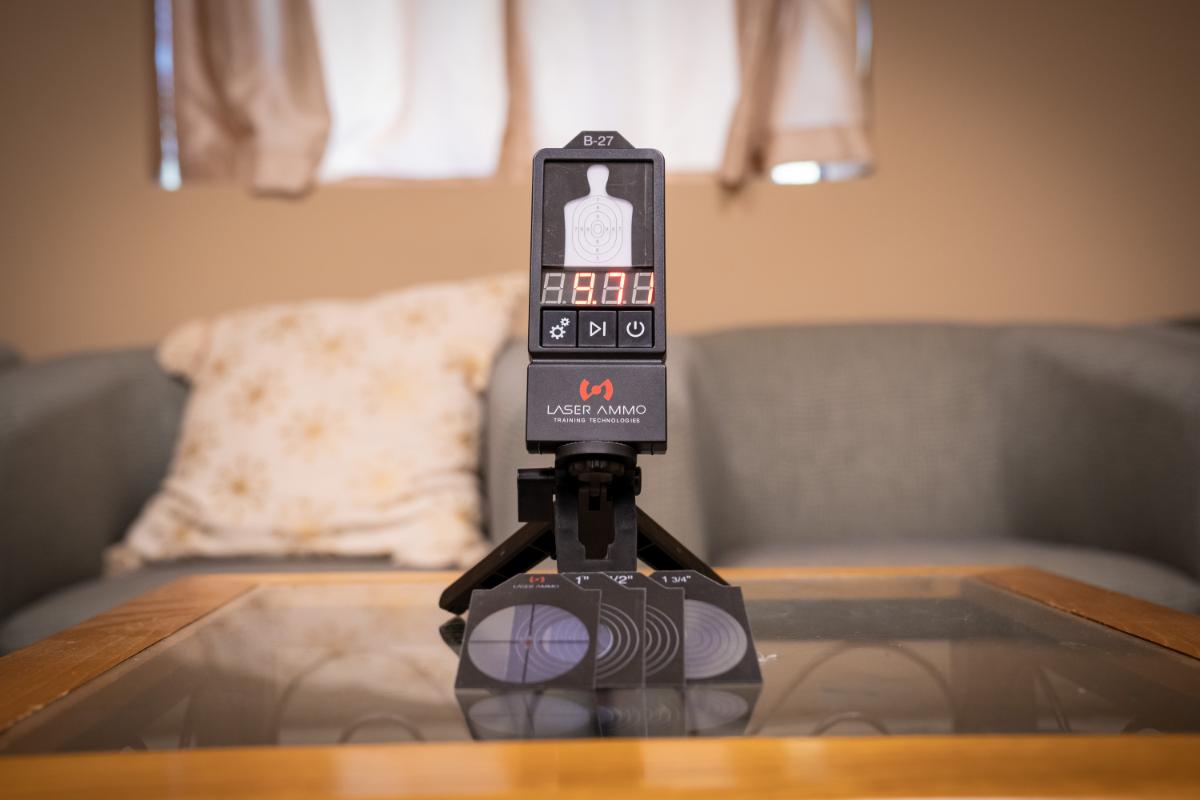
LaserPET™ II Electronic Target
The LaserPET™ II is a compact electronic target designed for home training. It detects laser hits from SureStrike laser cartridges and provides immediate feedback through lights and sound. Because of its small target zone, it naturally works well for scaled target training in limited spaces.
Benefits include:
- Portable and virtually NO set up
- Multiple training modes
- Instant visual and audible hit confirmation
- Ideal for dry fire practice in small spaces
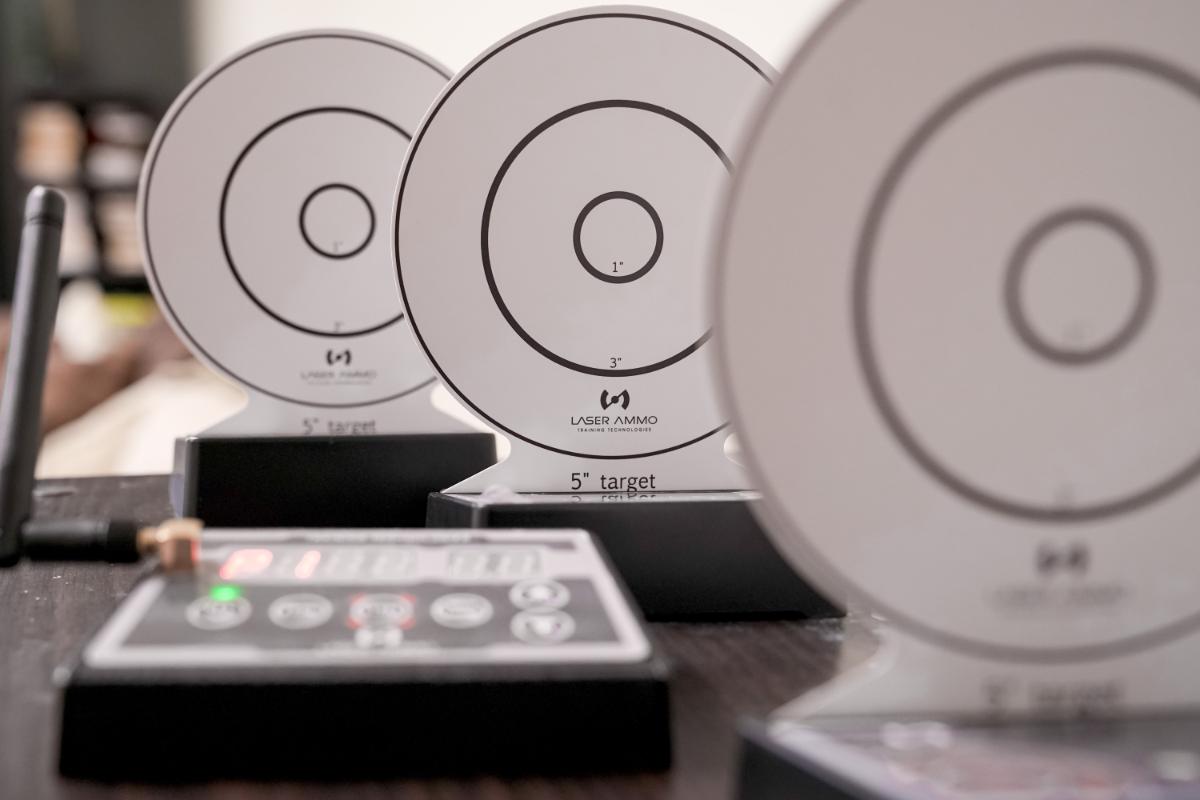
Interactive Multi Target Training System (IMTTS)
Our iMTTS expands training by using multiple interactive targets that communicate with each other and provide dynamic drills.
Laser Ammo offers scaled target options in the iMTTS line as well:
- IPSC version = 1/4 scale
- B-27 version = 1/5 scale
These target options make it easier to simulate practical distances indoors while still getting immediate visible hit indication and audible feedback. That makes training more effective, more realistic, and a lot more engaging than simply shooting at paper.
Benefits include:
- Multiple targets for realistic training
- Pre-programmed drills and reaction modes
- Visual and audible hit confirmation
- Scalable training for home, instructors, or ranges (meaning.. also portable)
Training Effectively at Home
Scaled targets allow you to simulate realistic shooting distances even when space is limited. Whether you are practicing in a small room, garage, or basement, combining scaled targets with electronic feedback can make dry fire training far more productive.
By adjusting target size and distance, you can replicate many of the same sight pictures you would see at the range while reinforcing fundamentals such as:
- Trigger control
- Sight alignment
- Target transitions
- Presentation from the holster
- Speed and accuracy under time pressure
Pairing that concept with electronic targets like the LaserPET™ II or iMTTS adds immediate visual and audible feedback, so you know exactly when you hit your mark. With a little understanding of scaled distances and the right tools, dry fire training at home can become one of the most effective ways to build consistency, accuracy, and confidence without ever leaving the house.